
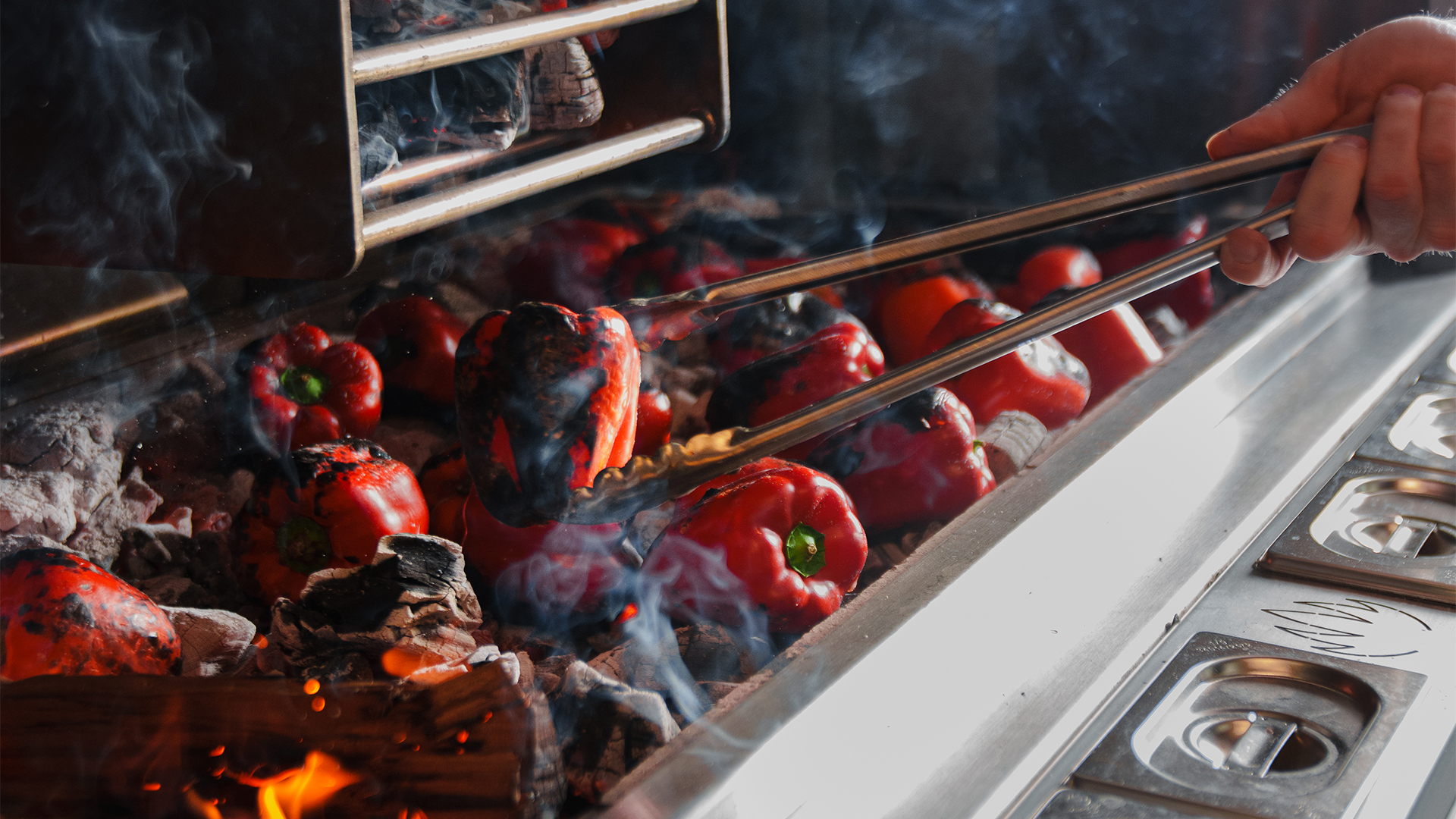
The almond wood goes on first.
Before the doors open, before the dining room fills with the low hum of a downtown Sacramento evening, before the first guest is handed a menu or the first bottle is pulled from the cellar - the wood goes on. Almond wood, sourced for the way it burns: clean, fragrant, with a sweetness that drifts into whatever it touches. Alongside it, Brazilian hardwood charcoal, chosen for the intense, sustained heat it holds long after the flame has settled.
By the time you arrive for dinner at Aiona, that fire has been building for hours. It isn't background. It isn't theater. It is the kitchen.
Why Fire? A Question Worth Answering Honestly
Live fire cooking is having a moment. You'll see the phrase on menus across the country right now, often attached to a gas-assisted grill with a few chunks of wood placed nearby for atmosphere.
That's not what we do.
At Aiona, live fire isn't a technique we apply to certain dishes. It's the organizing principle of the entire kitchen. Almost every plate that leaves our pass - the whole branzino, the souvlaki, the short rib, the vegetable sides - have been shaped in some way by smoke, char, or the radiant heat of a live fire. The question isn't whether to use the fire. The question is how to use it in a way that serves the ingredient in front of us.
To answer why that matters, it helps to understand what fire actually does to food, and why no other cooking method does it the same way.
What Fire Does That Nothing Else Can
It creates flavor that can't be manufactured
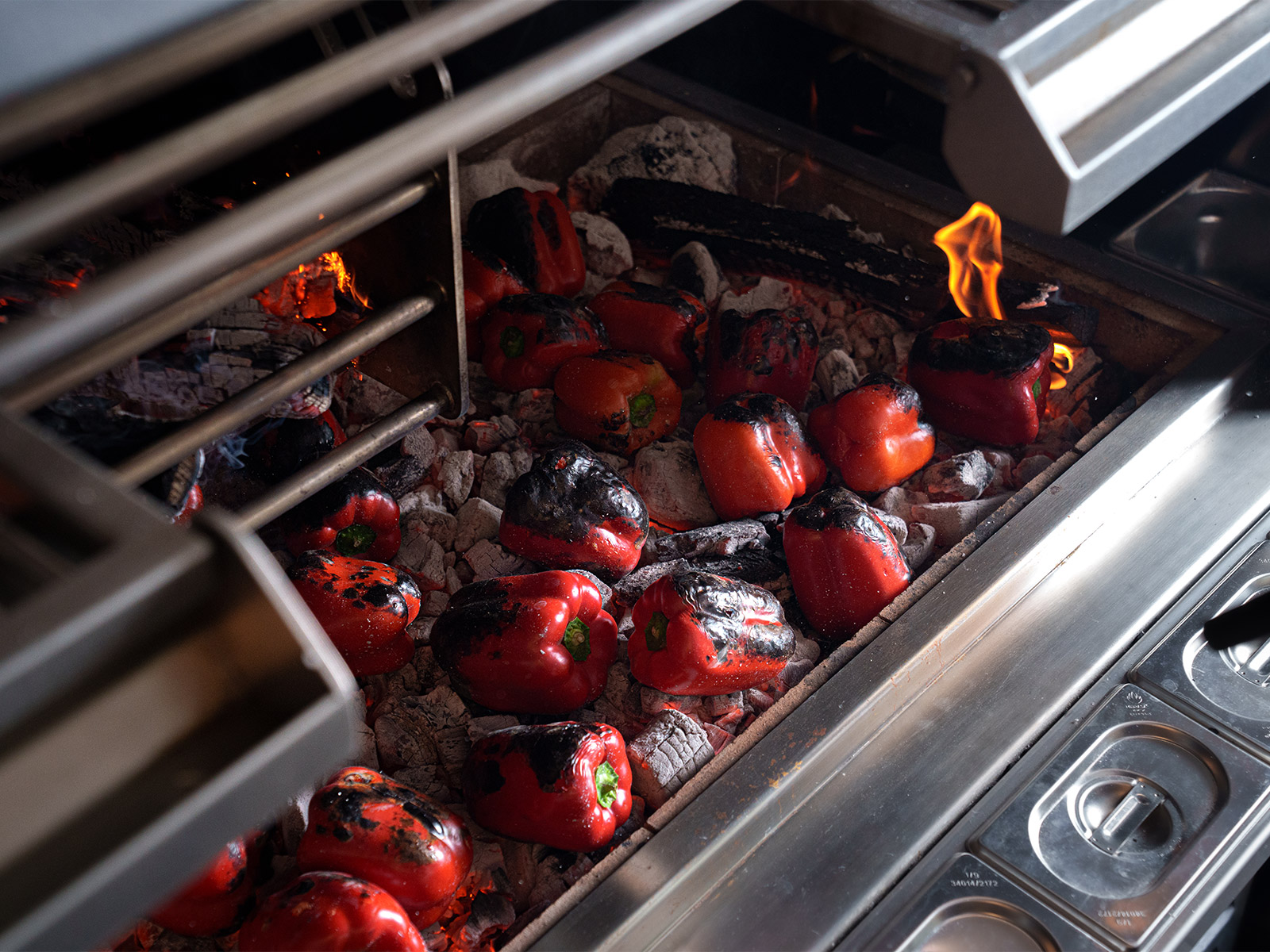
When proteins and sugars hit the intense, dry heat of live fire, a cascade of chemical reactions occurs - the same reactions responsible for the caramelized crust on a seared piece of fish, the crisp char on a piece of lamb, the darkened edges of a roasted pepper. Food scientists call it the Maillard reaction. Chefs call it the thing that makes people close their eyes when they take the first bite.
The key word is intensity. A conventional oven or stovetop can approximate some of these effects. Live fire creates them in a way that is faster, more uneven, and more layered - which is precisely why fire-cooked food tastes different. The char isn't uniform. The smoke isn't optional. The heat comes from below, above, and all around, and the cook's job is to read the fire and adjust, not to set a dial and walk away.
It adds smoke as an ingredient, not an accident
Smoke is flavor. The almond wood we use at Aiona has a specific aromatic profile - mildly sweet, clean-burning, with a subtle nuttiness that complements rather than overpowers. Brazilian hardwood charcoal adds a neutral, sustained heat that lets us drive deep, even cooking without excess smoke. Together, they create a layered fire environment where smoke becomes an actual ingredient in the dish, present at a level you might not consciously identify but would immediately notice if it were absent.
This is the part of live fire cooking that's hardest to explain on a menu and most apparent in the food. Our wood-roasted branzino doesn't taste like grilled fish. It tastes like a fish that spent time near a fire - which is a different thing, and a better one.
It demands presence
A live fire is alive. It breathes, shifts, flares, and dies back. It responds to wind, to humidity, to the moisture content of the wood, to how many things are cooking over it at once. You cannot set it and forget it. Every cook working the fire at Aiona is reading it constantly - moving proteins closer or further from the heat, rotating, adjusting, making hundreds of micro-decisions during a service that a convection oven would make automatically.
This is not inefficiency. This is craft. And the difference shows up in the food.
The Mibrasa: Precision Meets the Primal
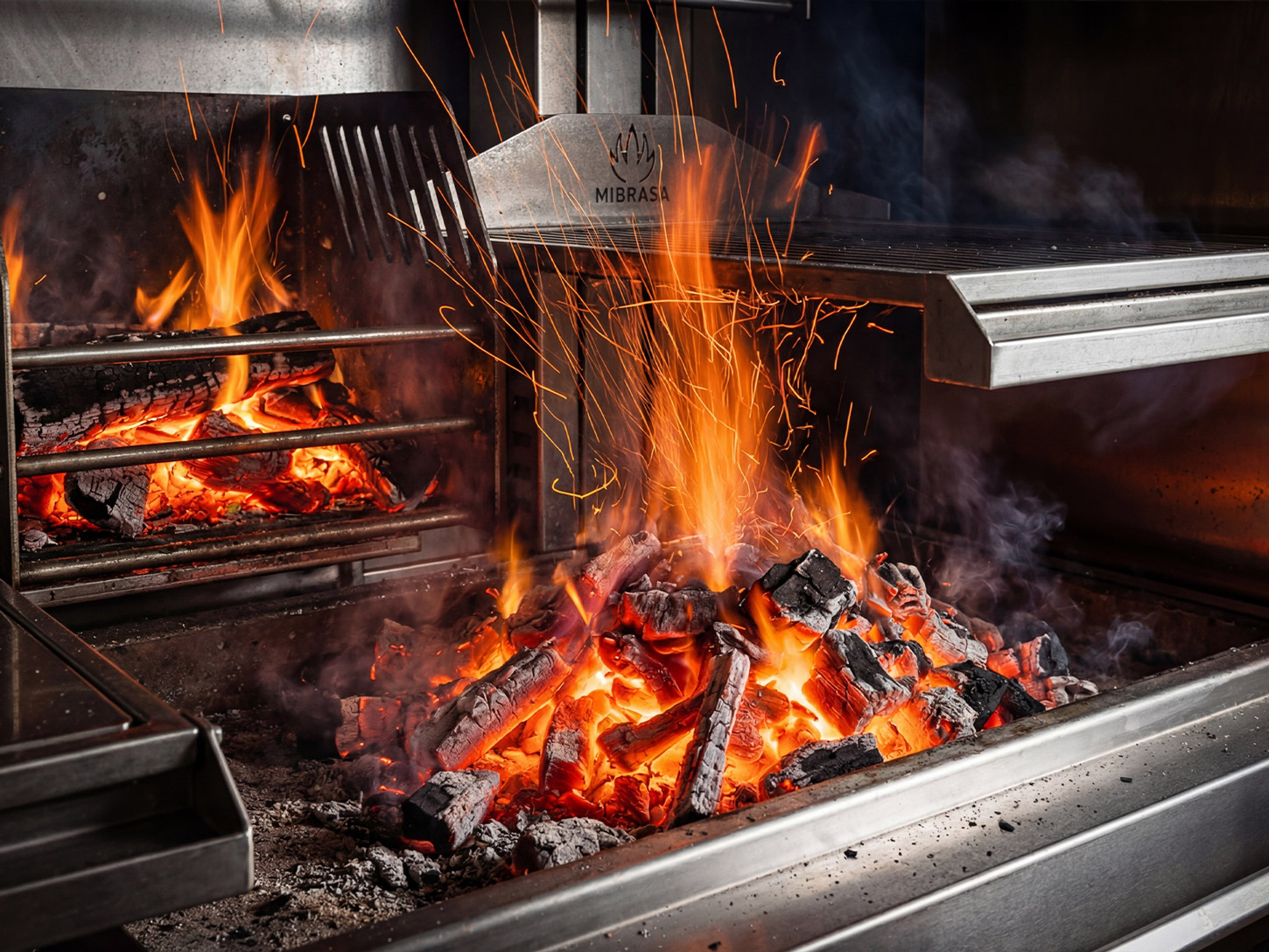
At the center of Aiona's exhibition kitchen sits a piece of equipment most diners have never heard of, imported from a small workshop in Palamós, Spain: a Mibrasa charcoal oven.
Fewer than 50 Mibrasa units are manufactured each year. The craftsmen who build them treat their work the way a luthier treats the making of a guitar - each one is a precision instrument, not a production item. Ours arrived in Sacramento as part of a kitchen build designed from the ground up around what this machine makes possible.
The Mibrasa solves a problem that has existed for as long as chefs have cooked with fire: how do you get the flavor of live fire with the control of a professional kitchen? Open-flame grills are dramatic and delicious, but they're also unpredictable at high volumes. Conventional ovens give you control but sacrifice the Maillard reaction, the smoke, the char. The Mibrasa sits at the intersection of both - a wood and charcoal - fired cooking system that can maintain precise temperatures while simultaneously bathing food in smoke and live-fire heat from all directions.
In practical terms, it means our rotisserie chicken - Mary's organic bird, wet-brined for 24 hours, rubbed with toum and hung on the rack for a day and a half before service - cooks in an environment of sustained wood fire heat that renders the skin to something close to lacquer and keeps the interior from ever drying out. It means our 72-hour short rib, after three days of slow cooking, gets a pass over the live fire that adds the kind of char and caramelization that transforms a technically perfect piece of meat into something that tastes like it was worth waiting for.
The Mibrasa is not magic. It is, like most excellent tools, simply very well designed for the job it was built to do. In the hands of chefs who understand fire, it extends what's possible.
Mediterranean Food and Fire: Why They Belong Together
The live fire technique at Aiona isn't a stylistic choice layered on top of a Mediterranean menu. It's the way Mediterranean food has been cooked for thousands of years.
The cultures that gave us hummus, branzino, souvlaki, and labneh did so without gas ranges and convection ovens. They cooked over wood fires, in clay vessels, on open grills above coals. The smoky char on a piece of grilled lamb in Greece, the wood-fired whole fish on the Adriatic coast, the slow-cooked stews of the Levant - these flavors are not accidents of history. They're the intended result of a method that evolved specifically because fire was what was available, and because generations of cooks discovered that fire-cooked food, prepared with good ingredients and patience, was simply more delicious.
What we're doing at Aiona isn't reinvention. It's return. We're cooking Mediterranean food the way it was designed to be cooked, with modern technique and the best equipment available, in the middle of downtown Sacramento.
Deneb Williams, who with Lee Hinton has spent years in a Michelin-recognized kitchen developing the philosophy behind this food, describes the approach simply: "Slow food is really just about cooking with the season. Slowing down." The fire enforces that discipline. You can't rush a live fire. You can only learn to work with it.
What This Means on Your Plate
Two dishes illustrate the live fire philosophy at Aiona as well as anything on the menu.
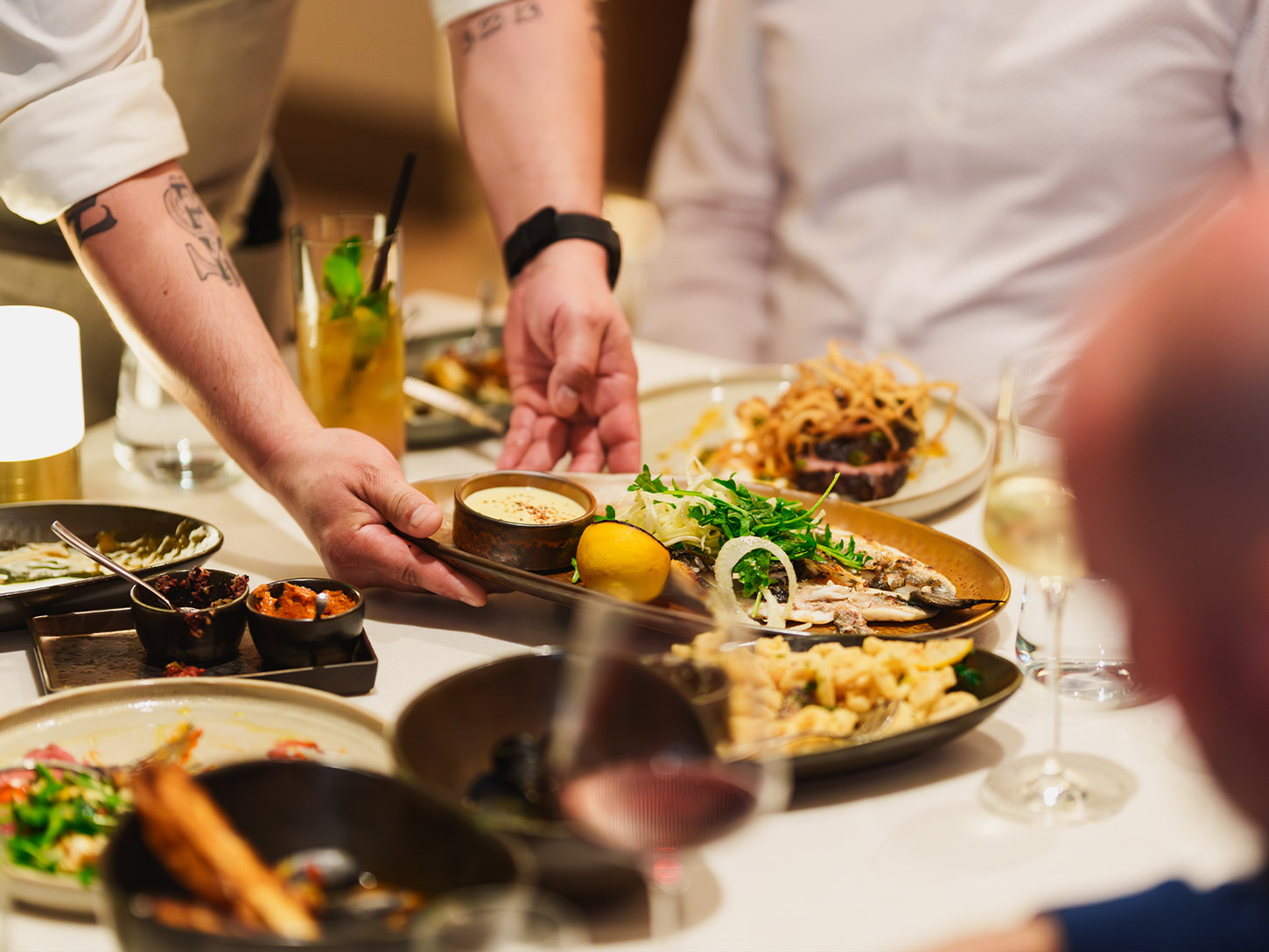
The wood-roasted branzino is a whole fish - a Mediterranean sea bass prized for its clean, delicate flavor and the way it responds to high heat. At Aiona, it goes over the Mibrasa in a way that chars the skin to a crisp, keeps the flesh just set and deeply moist, and layers in the subtle sweetness of almond wood smoke. Elizabeth-Rose Mandalou, our Beverage Director and Advanced Sommelier, pairs it with a Cuvée Monsignori Assyrtiko from Santorini - made from ungrafted vines more than 200 years old, briny and bright with lemon-peel acidity. The pairing exists because the fire in the fish and the minerality in the wine speak the same language: the Mediterranean coast.
The souvlaki is one of the oldest preparations in Mediterranean cooking - small pieces of marinated meat, cooked quickly over live fire, served simply. At Aiona, it's also one of the clearest demonstrations of what the Mibrasa and the right fuel combination can do. The char is immediate and deep. The inside stays tender. The smoke from the almond wood is present without competing. It is an ancient dish cooked the way it was meant to be cooked, on one of the best live-fire rigs in the country.
These aren't the only dishes built around the fire. Most of what comes out of our kitchen - the sides of gigante beans, the beets with farmer's cheese, the asparagus grown in the Sacramento Delta, the 72-hour short rib - has been shaped by the same philosophy: use the best ingredient, apply the right fire, don't get in the way.
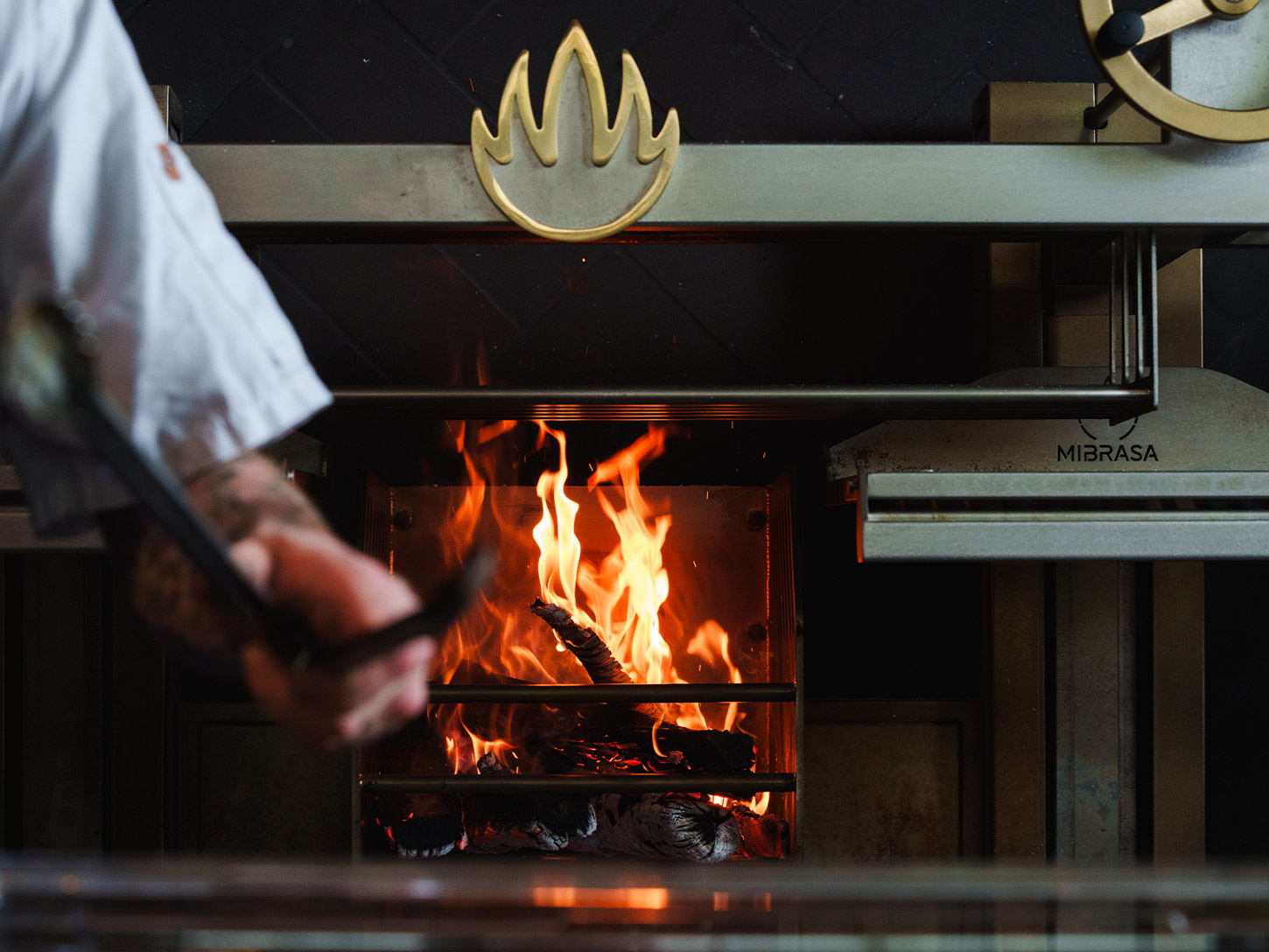
The Exhibition Kitchen: Why We Want You to See It
The fire at Aiona isn't hidden in the back of the kitchen. It's one of the first things you see when you walk in.
We designed the exhibition kitchen that way deliberately. The Mibrasa, the open grill, the cooks working the fire - these are the visual center of the restaurant because they are the actual center of the restaurant. The food comes from there. The smell of almond wood that greets you when you walk through the door on K Street comes from there. The warmth that makes the dining room feel like somewhere to settle in rather than pass through comes from there.
We've heard guests say that watching the kitchen changes the way the food tastes. We believe that. There is something about seeing a whole fish come off a live fire, seeing the char on a piece of lamb being checked and turned with the same attention you'd give something you were cooking for people you love, that connects the dish to the craft in a way a closed kitchen never quite manages.
Live fire cooking is transparent by nature. The fire shows you what it's doing. We think that's a good thing.
A Note on What We're Not Doing
Live fire is fashionable right now, and fashion invites imprecision.
We want to be clear about what live fire cooking at Aiona is and isn't. It isn't a wood-chip drawer placed next to a gas burner. It isn't smoke flavor added after the fact. It isn't a grill station operating in a kitchen that otherwise functions like any other.
It is a kitchen built around fire, fueled by almond wood and Brazilian hardwood charcoal, centered on a Mibrasa oven that was made by hand in Spain specifically for this purpose, operated by cooks who have spent their careers learning to read a fire and make the right call in the moment. It is a Mediterranean menu that makes sense with fire because Mediterranean food and fire have always made sense together.
It is, we think, what this cooking was always meant to be.
Come See It for Yourself
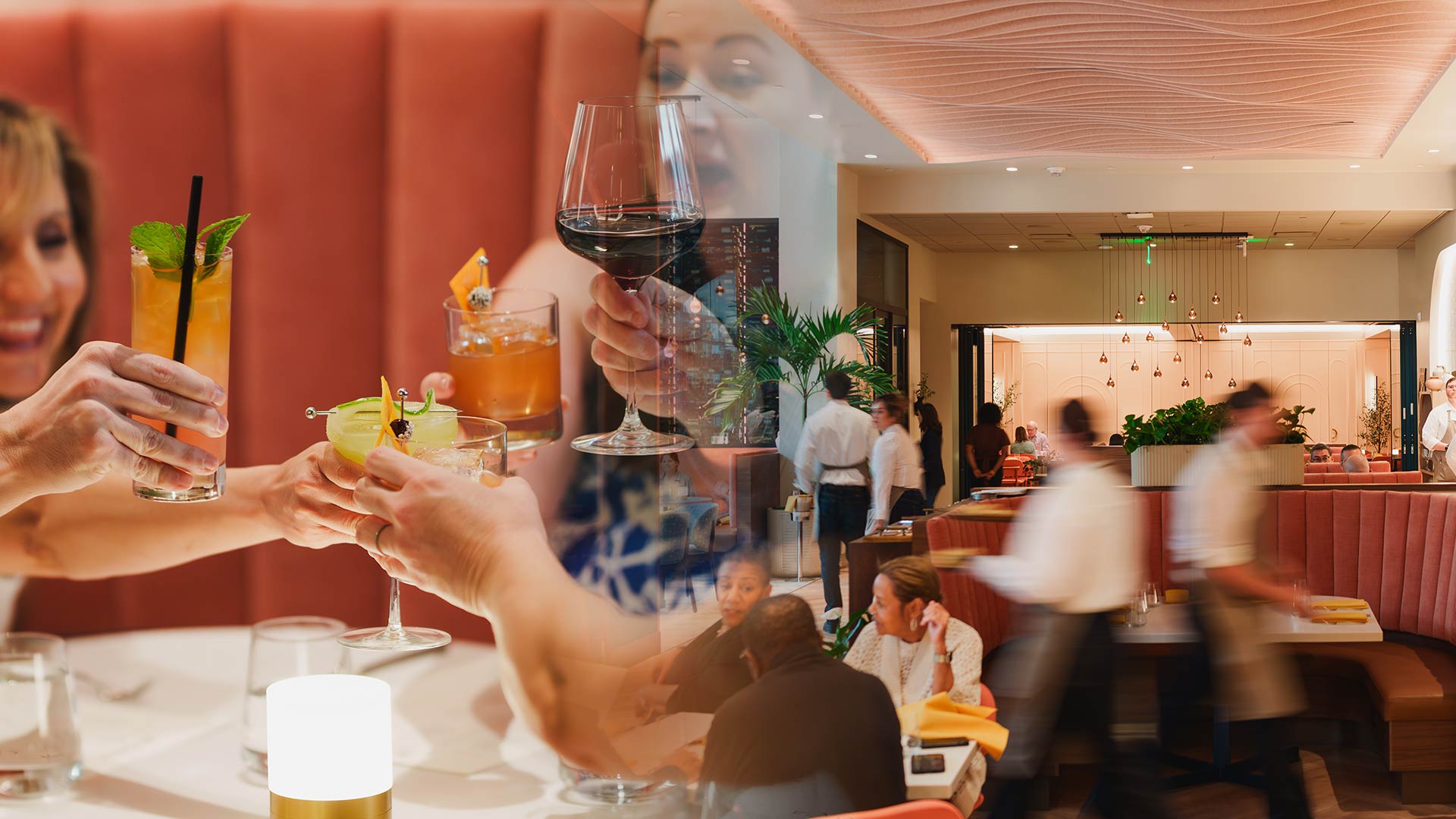
Aiona is open for lunch and Happy Hour Monday through Friday, and for Dinner Monday through Saturday at 1213 K Street in downtown Sacramento. The exhibition kitchen is visible from the dining room, the bar, and the patio. The fire is always burning.
If you'd like to plan your visit, explore our current menu - or come for happy hour if you'd like to start with a carefully hand-crafted cocktail or glass of wine from the cellar before committing to a full evening.
For groups and private events, our team would love to talk about building a night around the fire specifically for you.
.svg)
.svg)

.svg)


.svg)
.svg)